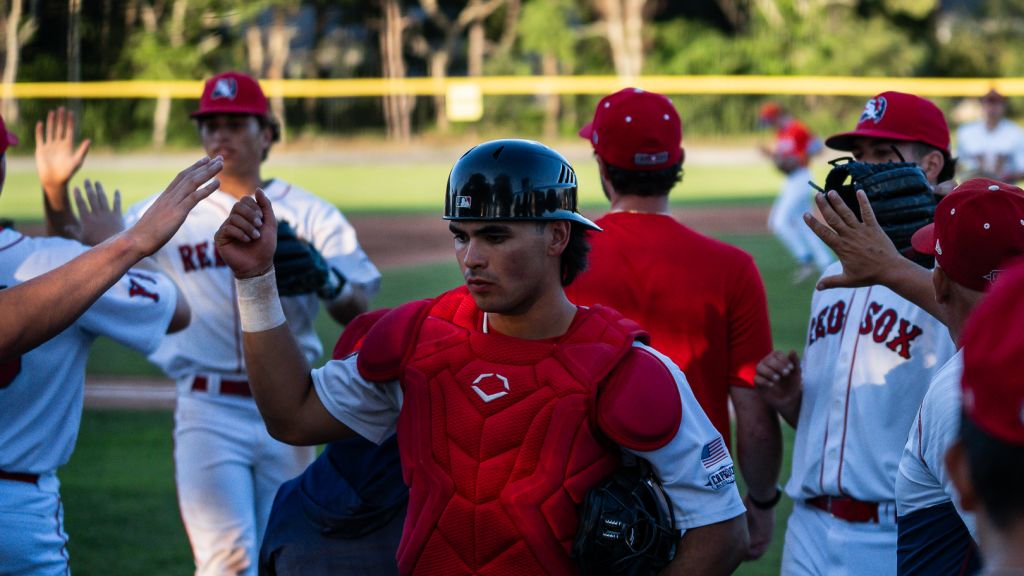
Since opening day of 2026, Y-D’s Mateo Serna has been a staple for the team both at the plate and behind it. The CCBL All-Star catcher, who will attend the University of Alabama as a transfer this fall, is hitting .317 with a .411 on-base percentage and a .524 slug.
But Serna’s player composition goes beyond his standout statistics. He plays for something bigger than himself: his Venezuelan heritage.
Serna wears a headband under his batting helmet. A few weeks into the season, his staple white headband turned into one printed with a Venezuelan flag. The catcher acquired the headband in late June after a deadly set of earthquakes hit Venezuela and resulted in more than 5,000 deaths, 17,000 injuries, and 18,000 homeless.
Serna’s parents were born in Caracas, Venezuela. The slugger was born in the United States but was raised in Doral, Fla., a town outside of Miami nicknamed “Doralzuela” due to its heavy Venezuelan population. Serna’s heritage is a massive part of his identity.
“I wasn’t born [in Venezuela], but I consider myself from there because all of my family is from there,” he said.
The catcher grew up visiting his dad’s extended family in Caracas. Although he hasn’t returned since 2015 because summer baseball began occupying his vacation time, Serna has fond memories of his visits.
“We still have the house [my dad] grew up in. So like I would go where he grew up, and just seeing how he grew up was super cool. [I enjoyed] just being where I feel like I’m actually from, like all of my family’s from there… the food [and] the weather’s awesome,” said Serna.
As a baseball player, Serna takes pride in watching Venezuelan players in Major League Baseball, like William and Willson Contreras (Milwaukee Brewers, Boston Red Sox) and Ronald Acuña Jr. (Atlanta Braves). He also shared his joy for Venezuela’s 2026 World Baseball Classic title.
“It’s kind of just showing what we have in Venezuela. It’s like a community,” he said.
Serna’s grandmother still lives in Venezuela. Although she was in the United States when the earthquakes hit and her residence was not at the heart of the damage, she returned to her home two weeks after the disaster to find shifted furniture and opened doors—over 90 miles from the quakes themselves.
“[The earthquake] didn’t really hit right there, but the earthquake was so big that it still shook the cities around it,” said Serna.
Because of his extended family’s proximity to the earthquakes, Serna is grateful for organizations like Boston Red Sox Foundation, which donated $300,000 to the Venezuelan Earthquake Disaster Relief Efforts Fund in support of various emergency relief organizations. He also noted that local groups in Doral have donated to relief efforts and praised their work.
“That’s awesome. Everyone’s kind of coming together in a community. Everyone’s coming together to help and send stuff over there, and like putting extra hours. It’s been crazy the amount of support that Venezuela has felt through this,” said Serna.
After the tragedy, Serna chose to bring the Venezuelan symbol onto the diamond with him as a way of “putting everything into perspective.” Like Y-D’s Jake Souders (Mississippi State), who uses prayer to remind himself that there is something bigger in his world than how he performs on the field, Serna wore the headband as a reminder that his heritage and persistence of his country, not a poor day at the plate, makes him, him.
“I don’t feel like I need to wear [the headband], but it’s kind of a want. Like you can have bad days on the field, but there’s worse stuff going on around the world,” said Serna.