There are many adjustments players have to make when they start playing in the CCBL. They play games every day instead of 3-4 times per week. They have a whole new set of teammates and coaches to get to know. Potentially most important, the aluminum bats that allow balls to fly off the bat in college are replaced with less forgiving wood bats like MLB players use.
Recognizing this, it is not uncommon for players to struggle at the plate in their first few weeks on the Cape. Home runs become deep fly balls, hard-hit ground balls become routine plays and line drives lose their dangerous speed that make them uncatchable.
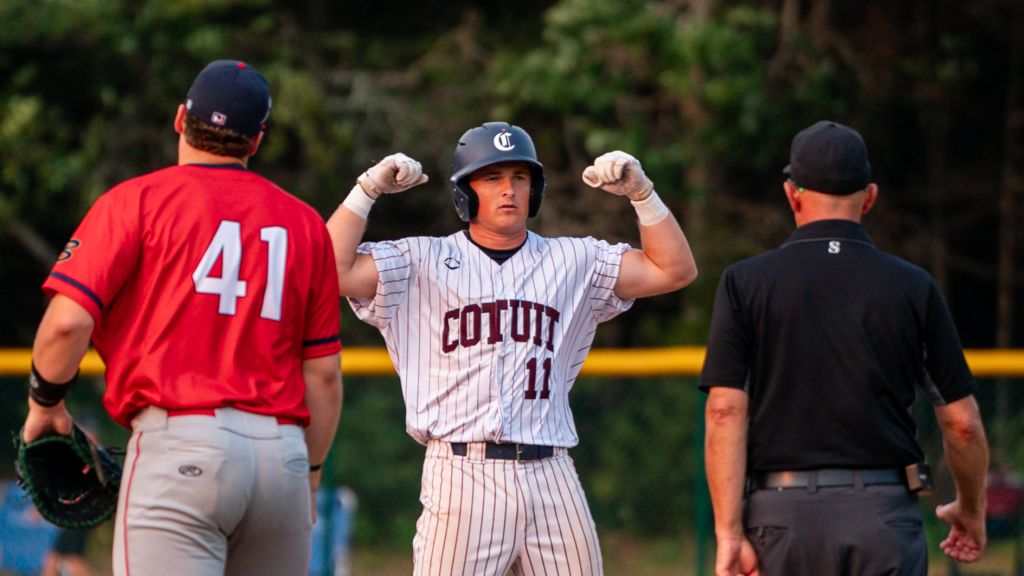
Nobody knows this struggle better than Cotuit infielder Noah Coy (Notre Dame). Through one week of the season he was hitting a measly .176 and was without a single multi-hit game. While not happy with the results, Coy did not freak out.
“There was no panic or anything like that…” Coy said. “I called my college coach and he told me to give myself some grace and trust that my swing would come around.”
Fighting Irish Coach Shawn Stiffler was right to tell Coy to trust the process. Since the start of July, the Greenwood, Ind. native has potentially been the hottest hitter in the league. Over the last 17 days he is hitting .476, with an on-base percentage of .593. In this stretch he also has 10 of his 11 runs batted-in and two of his three extra-base hits. Most incredibly, he has an OPS of 1.260, the highest amongst hitters with five or more at-bats. Simply put, Coy has been a machine at the plate.
There are plenty of potential reasons for the change in statistical success. Coy has been given a higher spot in the batting order recently, which may be more familiar for the near-perennial cleanup hitter at Notre Dame. It could also be just a greater familiarity with the team and coaches. However, Coy credits it to adjusting to the wood bats of the league.
“I knew there would be a transition period from metal to wood and it would be hard, I just had to trust myself even more,” Coy said. “Once I simplified things and got used to the wood bat it became so much easier to have more good at-bats.”

Fortunately, Coach Rob Cooper knew Coy’s potential to become an elite hitter in this league and had patience with the infielder. Cooper’s staff had a plan to help the Kettleers adjust to the wood bats.
“A lot of times guys come here having not played with a wood bat against this type of pitching and their college stats will not transfer immediately,” Cooper said. “My job is to tell them to not freak out, help them learn their swing with the wood bat and get them to embrace the grind.”
Little by little, the plan the coaching staff laid out worked for Coy.
“The coaches have been awesome. Coach Coop has been a huge help in developing my in-game mindset,” Coy said. “[Coach McKeon] and Coach Badeaux have also done a lot mechanically and approach-wise to remind me that I’m here for a reason and that I should trust myself.”
Coy is not the only one who has seen a remarkable stat increase once the familiarity of wood bats came into play. J.J. Moran (Stanford) had a .167 batting average 10 games into the year and now sits up at .254. Jesse Di Maggio (Dallas Baptist) batted a .105 through the first 10 games but is now all the way up to .264. The adjustments the Kettleers are making have worked, and the proof is visible in the stats.
As Cotuit continues to adjust to the wood bats over the course of the season, there is real potential for more offensive explosions like Coy’s. With the division playoff race being as close as it is, the Kettleers will be greatly serviced by these adjustments if they come to fruition.