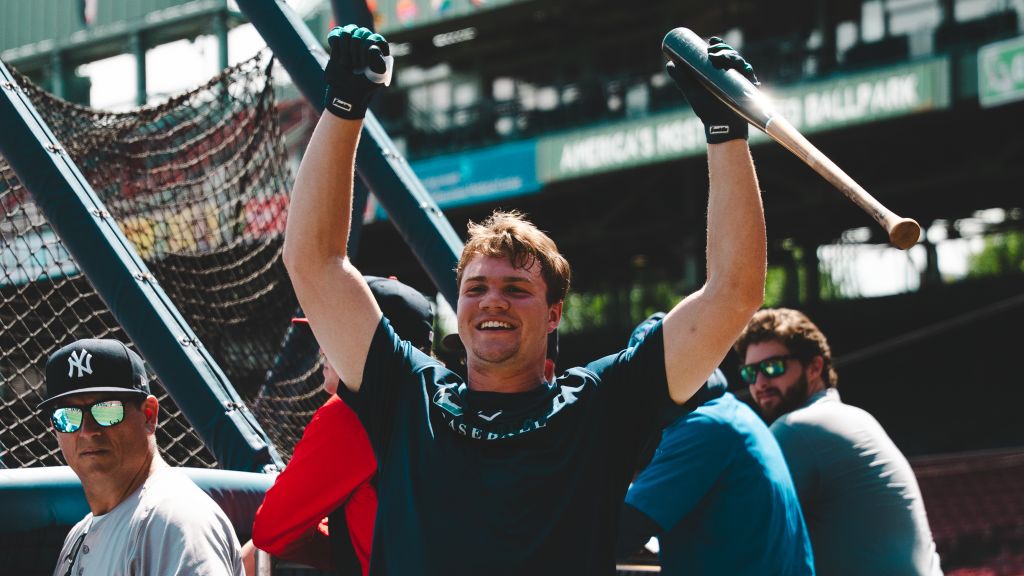
Jacob Lee spent the summer proving he was ready for professional baseball. When Brewster’s season ended on a walk-off double, the player who had answered every challenge struggled to answer one final question.
Minutes earlier, Harwich first baseman Sean O’Leary ripped the walk-off double down the right-field line, sending the Mariners sprinting out of their dugout and the Brewster Whitecaps walking silently toward right field. The hit ended Brewster’s 25-win season in the 10th inning, a 6-5 loss that eliminated the Whitecaps from the Cape Cod Baseball League playoffs.
Lee stood outside the visitors’ dugout and began reflecting on the year, the people who followed him to Cape Cod and his desire to play every inning of the summer as hard as possible.
Then his answer disappeared.
“Sorry,” Lee said, looking away as he tried to collect himself.
“You have to give me a minute.”
Lee walked toward Jane Sullivan, Brewster’s “team mom,” and accepted a much-needed hug.
Just a day prior, professional scouts named Lee the winner of the Robert A. McNeese Outstanding Pro Prospect Award. The Virginia Commonwealth catcher hit .301 with seven home runs, 24 RBIs and a .940 OPS across 28 regular-season games, establishing himself against elite collegiate competition.
Still, with the prestigious award freshly bestowed, Lee cried because he would no longer see the people around him every day.
“It’s just the people,” Lee said. “The people you meet along the way mean the most. The town, the people you do it for. I’m not really upset that it’s over. Just those people aren’t going to be in your life immediately like they were for the last three months.”
The award validated what scouts saw in Lee’s game. He is a 6-foot-2, 205-pound catcher with immense power, a strong arm and athleticism behind the plate. He entered the summer after slashing .336/.465/.621 for VCU, leading the Rams in all three categories and helping them win the Atlantic 10 championship.
The numbers explain why scouts view Lee as a professional prospect, but they do not fully explain how he became one.
Fred Stoots had watched Lee play for only a few months when he told Lee’s parents to prepare themselves.
Lee was an eighth grader on Matoaca High School’s junior varsity team when the COVID-19 pandemic ended the season. While Lee’s mother, Sonya, picked up spirit wear from the school, Stoots told her that her son’s baseball career could soon accelerate.
“Over the next couple years, a lot of stuff could be happening for Jacob,” Stoots remembered telling her. “He’s pretty special, not just athletically, but just as a person. So just kind of wrap your brain around how you’re going to handle how good he becomes at baseball. Be ready for that because it’s coming.”
Lee had not played a varsity inning.
“To hear that someone else with an objective point of view really thought this could actually happen for Jacob playing in college at the D-I level, that kind of solidified that we were supporting him in the right way,” Sonya said.
Stoots’ prediction did not make Lee’s rise effortless. Lee hit around .180 during his freshman season at Matoaca and, for the first time, questioned whether his ability would carry him much further.
“I was really bad,” Lee said. “That was one of the times when I was like, ‘I don’t know if I’m cut out for this anymore,’ but I stuck with it. And I’m here now.”
“I don’t like to quit,” Lee continued. “I think it was just like, I’m going to see it out, fix it, get better.”

Fixing it meant returning to his travel organization’s facility nearly every night, sometimes six or seven times a week. His parents drove him but rarely needed to push him. Sonya occasionally found herself hoping her son would finally ask to stay home.
“Sometimes I’d come home and go, ‘God, I wish you’d say he doesn’t want to go tonight. Can you just say, ‘Mom, I don’t want to go tonight?’’” Sonya said. “And literally, he never, he never didn’t want to go.”
The work became visible to Stoots during Lee’s sophomore season. With two strikes against a pitcher throwing around 90 mph, Lee reached the type of count that had repeatedly caused him problems. Instead of chasing, he widened his stance, adjusted his bat and took the pitch. Lee briefly looked toward third base, where Stoots stood smiling.
“If he does that, you’re not going to be able to stop this young man,” Stoots remembered thinking. “If he can do what he just did, the adjustment he made, you’re not going to be able to stop him.”
The taken pitch showed Stoots that Lee could recognize a weakness, accept instruction and adjust on his own. By his senior year, he batted .551 with eight home runs and became the Region 5C and Chesterfield County Player of the Year.
His swing drew attention, but his catching career began almost by default. Lee’s father, Whitley, coached Little League, and none of the other parents wanted their children absorbing foul tips behind the plate. He volunteered Jacob.
Lee took to the position and refused to leave it.
“He wants to be involved in every play,” Whitley said. “If there’s a game going on, he wants to be behind the plate.”
The physical tools appeared early. Lee touched 90 mph on the mound as a freshman and possessed the arm strength needed to control the running game. Becoming the voice directing the other eight defenders took more time.

Lee was naturally reserved. Whitley remembers watching professional catchers with him and pointing out how they controlled the field.
“He’s the manager on the field,” Whitley told him. “You need to start working on that.”
Lee gave his familiar response.
“OK, yeah, I got that.”
By his senior year, Stoots rarely needed to direct the defense. Lee called out assignments from behind the plate, encouraged teammates and demanded more from the group around him.
“He took control of the field,” Stoots said. “It’s like having a coach on the field, and he also built everybody up around him. He made everybody better, not just baseball-wise. Better people and just better teammates.”
That leadership followed Lee north.
Even when he was not catching for Brewster, Lee rarely disappeared into the dugout. He hovered near the on-deck circle, talked with hitters, played catch between innings and spent time with the Whitecaps’ bat boys. Shade and silence never seemed particularly interesting to him.
Scott Grimes has watched his son, Onyx, spend four summers around Whitecaps players. Some embraced the children following them around Stony Brook Field. Others kept their distance.

“It takes a special kid to understand little kids,” Grimes said. “I go based off Onyx’s reactions and who he gravitates towards, and you start to see who those guys are very quickly. [Lee] was one of the immediate ones, and he’s a phenomenal, phenomenal kid.”
Long before Onyx gravitated toward Lee, Stoots watched him offer the same attention to Matoaca’s seldom-used players. Lee would sit after games with a teammate who might play only three innings all season. They laughed, talked about food and treated each other as equals.
“To that young man, it’s like he’s just as big a part of the team as Jacob is,” Stoots said.
Lee’s attachment to people has also shaped some of his most consequential decisions.
He grew up attending VCU games, committed before his sophomore year of high school and stayed through multiple coaching changes. Despite consecutive 17-home run seasons and the attention that followed, Lee never felt compelled to enter the transfer portal.
“A lot of my best friends I met at VCU,” Lee said. “I love the place there. Coaches take care of you. There are just a lot of good things going into VCU, and I really saw you can have a lot of success at VCU and you can get drafted pretty high. I love where I’m at.”
His choice was personal, not a judgment of players who transfer. VCU already offered the relationships, development and opportunity Lee wanted.
The same mindset kept him in Brewster through the final pitch. Cape League rosters change throughout the summer as players reach workload limits or receive instructions from their college programs.

Lee did not see the point in coming all the way to Cape Cod without trying to win a championship.
“I came up here with one goal, and it was to play great all summer and win,” Lee said. “You can’t do that if you leave after July 4th or something like that.”
Brewster fell short, but not before clinching a playoff berth with 11 regular-season games remaining and finishing 25-12-3. Facing elimination in Harwich, the Whitecaps collected 13 hits and carried a two-run lead into the bottom of the seventh. Lee’s RBI single in the fifth put Brewster ahead before the Mariners tied the game and ended the series in the 10th.
Less than a week later, Harwich defeated Bourne in a decisive third game to win the Cape League championship. The team that ended Brewster’s season became the last one standing.
It was not the only time Lee was stopped by the summer’s eventual winner. Weeks earlier, Cotuit’s Brady Christman hit nine home runs in the opening round of the Cape League Home Run Contest to eliminate Lee, then continued through the field and won the competition.
Neither loss became easier in hindsight, but together they clarified the level at which Lee operated throughout the summer. He competed in the league’s power showcase, pushed the eventual Cape League champion into extra innings and finished as the player scouts considered the Cape’s top professional prospect.
Lee’s emotion after the final loss came from everything surrounding the result.
“I would 100% do it again,” Lee said. “It’s just baseball. There’s no politics. There’s no coaches recruiting people. It’s not your school ball. It’s not professional baseball. It’s just a town rallying around 35 guys for a whole summer. It’s so pure in that way, and that’s why it’s so awesome.”
Professional baseball will not remain that pure. The minor leagues introduce transactions, contracts, long bus rides, cheap hotels and daily competition among players fighting for limited jobs. Catchers absorb an additional toll, learning new pitching staffs while enduring the demands of the sport’s most physically punishing position.
Lee has not reached that stage, and no award guarantees he will. But his career has already tested the qualities professional baseball demands: adjustment, durability, communication and the willingness to keep working when the immediate rewards disappear.
The McNeese Award reflects scouts’ belief in Lee’s ability to reach the next level. Grimes sees another reason he may last once he gets there.
“People will remember him more just for the kid that he is than what he is on the baseball field,” Grimes said.
Scouts recognized the player Lee became during the summer. Grimes believes the person behind that player could shape what comes next.
“His personality is infectious,” Grimes said. “People want to be around him, and they listen to him. You can just tell he’s one of those leaders. That will carry him further in the game than his talent will.”