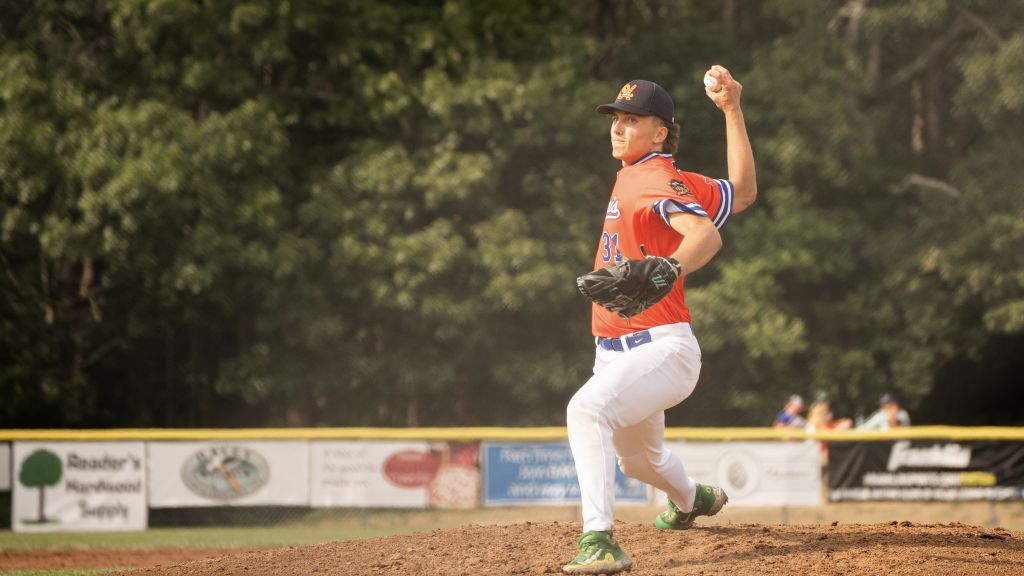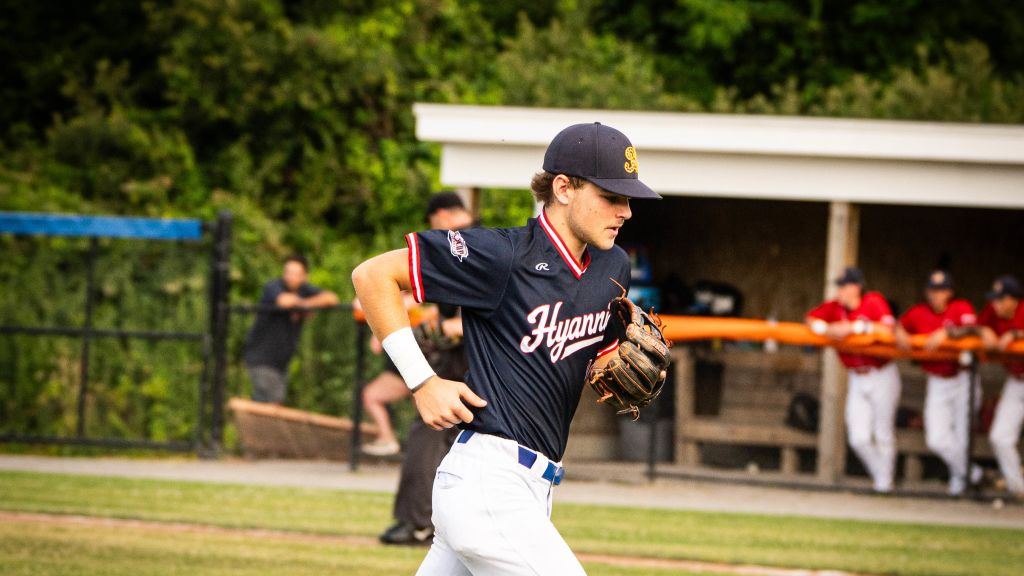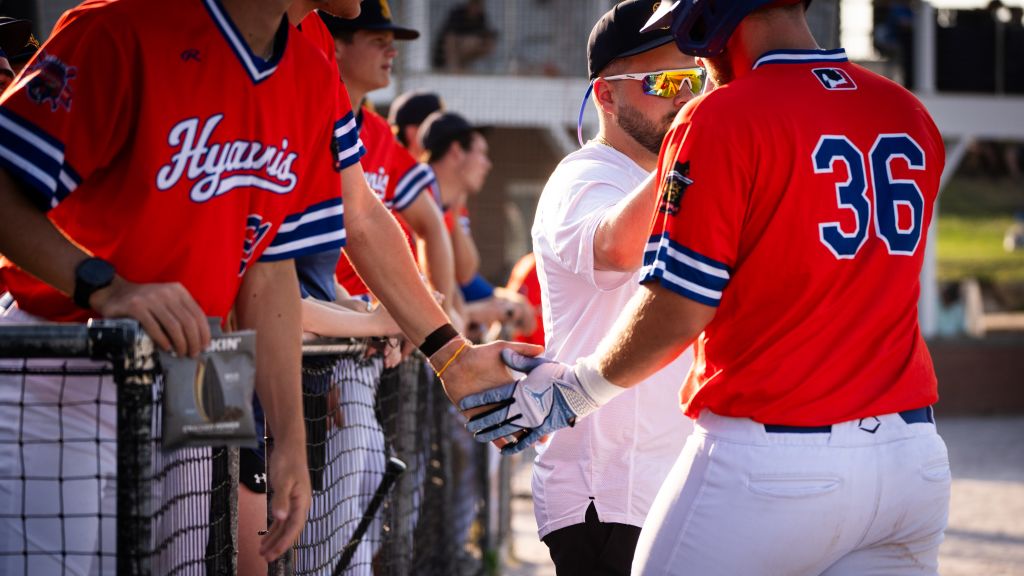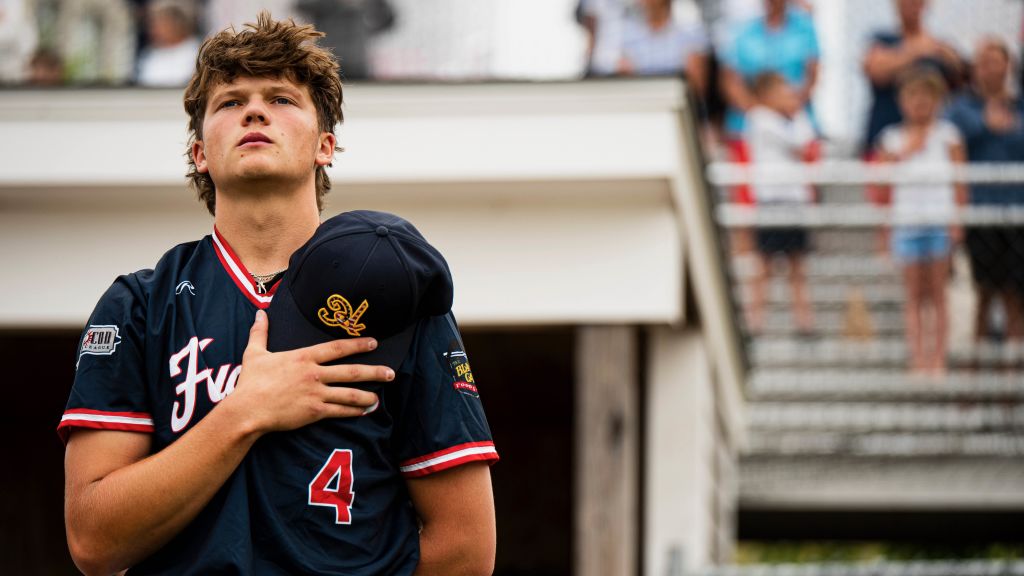
When University of Iowa pitcher Kyle Alivo arrived on Cape Cod to play for the Hyannis Harbor Hawks, he didn’t expect to be crowned the league’s best pitcher through the first week of the season. He certainly didn’t expect to be one of the league’s few two-way stars, contributing both on the mound and in the batter’s box.
Hyannis general manager Nick Johnson says Alivo wasn’t advertised by his agent as a two-way phenom, but as a “back-end piece” with high upside. He hadn’t regularly started games at the collegiate level: Iowa used him primarily as a reliever, and he started only two of 34 games he appeared in during his redshirt freshman year with the Hawkeyes.
But Alivo got the start in Game 2 of the season, holding the Wareham Gatemen scoreless for four innings in what would end up a shutout win for the Harbor Hawks. He struck out four, walked one, and gave up only two hits.
On June 20, he took the mound in Cotuit against the Kettleers, and held Hyannis’ rival hitless for four innings, striking out four more.
The league named him the season’s first Pitcher of the Week.
“It was awesome,” Alivo says. “I was excited about it. I’m happy that we got the win in both games that I pitched.”
Team management was more than pleased with Alivo’s hot start, but on June 24 came what Johnson says was one of the biggest surprises in his tenure in charge of the Harbor Hawks.
With usual second baseman Taylor Kirk getting the day off, Alivo got the start at second base – his first appearance of the year as a position player.
Johnson knew Alivo could play two-way – he got 28 at-bats with the Hawkeyes, batting .286 with an .869 OPS – but “until a couple nights ago, we didn’t know how good that was,” Johnson says.
Batting eighth – perhaps manager Mitch Karraker didn’t realize how good he was, either – Alivo went 4-4 with an RBI, a double, and a solo home run in the fifth inning, as the Harbor Hawks defeated the Orleans Firebirds 6-4.
“Anyone can run into a fastball [for a home run], whatever,” Johnson says. “But he backed that up all night. That’s not a fluke, that’s an athlete who has a plan.”
Johnson says he would have been “happy if [Alivo] wasn’t striking out” all night. Instead, Alivo blew him away.
“His home run was the least hard-hit ball he hit that night,” Johnson says. He recalled the home run ball traveled 93 mph out to left-center, while his other hits were smoked at 95 mph or more.
The next day, Alivo got the start at designated hitter – though the Hawks lost to the Harwich Mariners, he got another hit, a walk, and hit a long flyout that nearly cleared the outfield wall.
“I never thought he’d ever step foot in the batter’s box for a live at-bat in the game,” Johnson says. “It was immensely impressive.”
Johnson and Hyannis’ baseball operations department didn’t find Alivo through traditional methods of scouting and combing through collegiate baseball records. Instead, even before Alivo had thrown a collegiate inning, his agent approached Johnson, with whom he has a trusting relationship based on prior clients’ track records with the Hawks – and “we ended up making the decision to take him, and obviously he’s turned into exactly what was sold to us,” Johnson says.
Johnson identified Alivo as a “Swiss Army knife-type player.” With all the roster turnover that Cape League teams withstand over the course of a season and all the holes opening up across the diamond and on the mound that must be swiftly plugged, “if this guy can play multiple positions and give us innings, that’s a no-brainer,” Johnson says.
Though Alivo has mainly pitched in relief at the collegiate level, he has the arsenal to start. Johnson was intrigued by his fastball velocity and commended his secondary pitches. Alivo throws a four-seam fastball that tops out at 97-98 mph, a sinker or two-seam fastball, a “gyro slider” – a “sharper” version of a regular slider – a 12-6 curveball, and is developing a splitter or changeup.
Johnson originally planned on making Alivo a closer due to his innings limit, but chose to give the pitcher with starting potential the chance to go long. It may minimize the time Alivo will spend on the Cape, but he’s determined to make the most of it.
After playing for the Kenosha Kingfish of the Northwoods League in his native Wisconsin going into his freshman year, Alivo decided he wanted to venture into uncharted waters this summer.
“I was staying at home in the Northwoods,” Alivo says. “I wanted the true college summer ball experience. And the Cape’s got really good competition, and I wanted to see how my stuff played against those guys.”
Of course, Cape Cod is a world away from Wisconsin, and he’s had to make adjustments. Alivo says it’s “a little tough” managing when he can see his family and girlfriend, even when they come to the Cape to see him play.
On a typical off day, Alivo can be found hanging out with his friends or his girlfriend, fishing, or driving around and finding new spots to eat.
He says “meeting new players from all over the country” has been his favorite part of playing in the Cape League.
“You’ll see them as you play them in school ball,” he says, “but I think it’s really cool to play on a team where everybody comes from a different place.”
Far away from home, Alivo now lives with Hyannis bench coach Rich Cogliano, along with first baseman Trey Hawsey and outfielder JP Head, who are both from the Deep South.
That arrangement came about from two important connections: Both Alivo and Cogliano are Italian, and both attended the University of Iowa.
“Rich and his family have been really welcoming,” Alivo says. “I’ve had a blast staying there.”
Cogliano likes to say Alivo’s “got a golden horseshoe somewhere, hanging.”
“He’s a natural winner,” Cogliano says. “Everything he touches works, that’s not by mistake. He’s a hard worker, and he has a lot of good fortune, because he’s that kind of kid.”
Many, if not most, baseball players with high-level or MLB potential both pitch and hit in high school, but that usually ends once players enter their college years. At this level, it takes an incredible amount of work to play on both sides of the ball.
“Shohei Ohtani’s success in MLB makes people think that it’s easier than it is,” Johnson says. “It’s incredibly hard to be as good as he is at both.”
Alivo says it was his lifelong dream to be a pro infielder, even though his pitching talent has taken him to the mound. But he’s stayed dedicated to both sides of his dream, and credits his coaches at Iowa for helping him create an easy schedule to get in twice as much work as the average player.
At school, he’ll practice and stretch with the rest of the position players, then meet the pitchers and start his throwing drills.
“Then I’ll hop right back over and do ground balls, team [defense] and stuff like that,” Alivo says. “Then, the hitting stuff after that stuff’s over, then we’ll go lift, so I get everything.”
Alivo works hard because “being able to play every day you possibly can is something you shouldn’t take for granted,” he says – he’s been through adversity, in the form of a UCL tear and Tommy John surgery that limited him to six games in his senior year of high school.
After two months of “sitting there, pretty much doing nothing,” Alivo says, it was off to physical therapy to begin the recovery process. It was “a grind for sure, but I stuck to it,” and Alivo is grateful that Iowa – the school to which he committed in his sophomore year of high school – stuck with him.
“I’ve had the time of my life playing the last two years,” Alivo says. “I made my best friends and had great opportunities, traveled all over the country to play, and I’m really grateful for those.”
Alivo is, by all accounts, one of the players with the most potential on this Harbor Hawks team. Team management believes he will be a name to watch when he enters the MLB draft.
“The sky’s the limit for him,” Cogliano says. “I think he’s a major leaguer.”
Johnson thinks Alivo could be drafted in the first round.
“My guess is that’s an arm,” Johnson says – in the vast majority of instances, MLB organizations prefer prospects to focus on one side of the ball – but “a coveted arm, that’s going to be paid handsomely to pitch.”
Although “it would be a blessing to get drafted by anybody,” Alivo would like to be drafted by his hometown Milwaukee Brewers, if he had to choose.
Growing up in Franklin, Wisconsin, a suburb of Milwaukee, he’s a big Wisconsin sports fan – and says if there’s one thing he’d like Hyannis fans to know about him, it’s that he’s a big fan of the NFL’s Green Bay Packers.
“I know a lot of people around the country love the Packers,” Alivo says. “That’s something I can connect with the fans on a little bit, if they’re a Packer fan.”
Sadly, Alivo won’t be in Hyannis all season. He’s on an innings limit, determined by his coaches back at school, who don’t want him to tire out his arm in preparation for his sophomore season.
He’ll leave in early July – “he wants to be here for the Fourth, but we knew when he came down what his limitations were going to be, and we’ve met them,” Cogliano says – then visit his loved ones and return to Iowa to work out and prepare for the Hawkeyes’ upcoming campaign.
“I just want to win,” Alivo says. “Going back to Iowa, I’m excited to play with all my buddies again and have a chance at competing for a Big 10 title. The biggest thing to me is just have fun while we’re doing it, and create a winning culture.”
But Alivo will never forget his experience on the Cape, and Hyannis surely won’t forget the man who will hopefully be another addition to its vaunted roster of alumni in the majors.
“I’m happy with it,” Alivo says. “Just going in there with confidence and grateful for the opportunity that God’s given me to play in this league, and having fun playing with the boys, and just keep it rolling.”