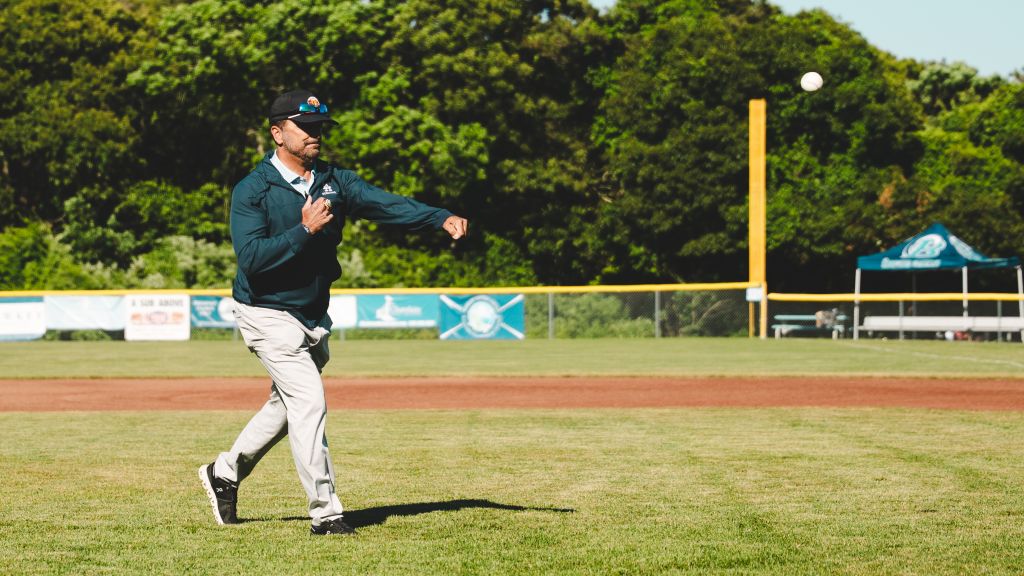
BREWSTER, Mass. – Baseball in hand, Thomas Myers III walked out in front of the mound at his old stomping grounds, Stony Brook Field. He went into his motion, kicking his left leg and firing a bullet toward home plate, where it found the leather of a catcher’s mitt, making its presence known with an audible pop.
The southpaw still has it.
Myers, 56, has worked in amateur scouting — first with the Chicago Cubs and now with the Los Angeles Dodgers — since October 2011, but before that, he occupied a different role in the baseball stratosphere, serving as the manager of the Brewster Whitecaps from 2009-11.
He found his way back to Stony Brook on Tuesday, where he was introduced to the crowd and threw out the first pitch prior to the Whitecaps' eventual 5-3 victory over the Wareham Gatemen. The former skipper arrived roughly three hours before game time and stuck around to catch the action.
“The drive from Boston here to the Cape — a lot of memories were coming back,” Myers told Brewster Whitecaps feature reporter Rome Kadi. “My time here in Brewster, even though it was just three summers, were some of the best baseball moments I’ve had.”
Myers was hired in the winter before the 2009 season, thanks in part to his own desire to diversify his portfolio, a connection to a Pittsburgh Pirates scout who knew the late Barry Souder, a co-founder of the modern iteration of the Whitecaps, and his resume, which featured stops in the California Collegiate League, where he was the pitching coach for the Santa Barbara Foresters, and the Alaskan League, where he was the head coach of the Peninsula Oilers.
In addition to his summer escapades, Myers had served as the associate head coach and recruiting coordinator for UC Santa Barbara since 2005, previously working with the program from 1998-01 as a pitching coach, and spent the intermediate period as a pitching coach for Santa Clara.
The jump to coaching was natural for Myers, who had been around sports all his life. His father, Thomas Myers Jr., played collegiate football at San Jose State from 1961-63 and later officiated in the NFL, but it was baseball that called to the younger Myers.
“I realized at a young age, you don’t have to be big in stature and (have) the most intimidating presence as a baseball player,” Myers, who’s Baseball-Reference page lists him as 5-foot-11, 175 lbs, said. “It allows opportunities for everybody.”
Myers worked his way up the ranks, from San Jose City College to Arizona to UCSB, where he was drafted by the then-Oakland Athletics in the 39th round of the 1991 MLB Draft. Myers spent parts of five minor league seasons in the A’s, Orioles and Cardinals systems, along with some time in independent ball and in the Netherlands, where he was a player-coach for a Dutch Professional League team in Haarlem during the summer of 1996.
Myers found himself coaching and playing in Europe thanks to a former college coach having a connection to the MLB Envoy Coach Program, which would send coaches around the world to help teach the game.
“It was like a world history book coming to life for me,” Myers said.
After spending his summer in the Netherlands and the collegiate season as an assistant coach at Porterville Community College, Myers got a job working in communications for a technology company. He still had the itch for baseball, however, and all it took was one phone call to truly kickstart his coaching journey.
“My old coach at UCSB (Bob Brontsema) had reached out to me and said, ‘Hey, how would you like to be my pitching coach? We have this young left-hander who’s getting a lot of attention from other schools, and we need to keep him here.’” Myers said.
The name of the young left-hander? Barry Zito — 2002 American League Cy Young winner and 2010 and 2012 World Series champion.
Zito eventually left anyway — first to Los Angeles Pierce College and later to Southern California — and Myers wasn’t able to spend much time coaching the future star, but the decision to say yes set off a chain of events that took him all the way to Brewster.
With the Whitecaps, Myers amassed a 63-59-10 record, missing the playoffs in his first season, but reaching them in his final two, although both campaigns ended with round one losses.
Myers referred to his first year on the Cape as “a good learning lesson." He didn’t personally recruit the team, instead inheriting players he had to balance.
“I tell people, every day is an All-Star game; the rosters are all equivalent. It’s just learning your personnel on the fly,” Myers said. “What I learned was where do you put them to have success. Winning is part of it; it's a big part of everything we do in baseball, but this is also a showcase environment for the players. You’ve got to figure out how to budget your players, make sure they're on the field so the pro evaluators can see them play and then try to win games.”
After three years at the helm, managing future big leaguers like Jedd Gyorko, Mark Chana and Kyle Hendricks, it was time for Myers' next adventure. Change was coming atop the ladder at UCSB, and while Myers interviewed for the head coaching position, he knew the program was looking for an outside voice.
That caused Myers to switch gears to scouting, landing a job with the Chicago Cubs, working under scouting director Tim Wilkin, whom he met during his final year in Brewster.
Myers worked with the Cubs from 2011-21, canvassing Los Angeles, California’s Central Coast, Bakersfield and Las Vegas for the best amateur players — and not just in terms of on-field ability, as scouts need to be conscious of an organization's culture as well as the budgetary restraints of the MLB Draft.
While working with the Cubs, Myers recommended DJ Peters, Eric Uelmen, Cory Abbott and Darius Vines, who have all made the major leagues. With the exception of Abbott, each player was drafted after the second round.
“Later in the draft, that’s where us scouts really have our value,” Myers said. “Parents that come to these games, their families and the grandparents, they know who the good players are. It's the guy who's on the outside, on the edges, and that's where we need to learn about them, watch them play, and that recommendation, if they make the big leagues, that's kind of a feather in your hat.”
Myers began working with the Dodgers in November 2021, continuing much of what he did with the Cubs while periodically participating in player development and operating the Dodgers Scout Team, which consists of some of the best high school players in the nation.
The team barnstorms against local collegiate teams in order for the players to get evaluated by both DI programs and major league organizations.
“We’ll get guys that continue to graduate, move up the ladder, but we want to get to them young, just build a foundation with them,” Myers said.
In addition to his work with the Dodgers, Myers owns and operates the Santa Barbara Grizzlies Baseball Group, a nonprofit organization that supports the development of baseball players from middle school all the way to the college level.
“Creating all these opportunities is keeping kids playing baseball,” Myers said. “Eventually, one of these guys, or several of these guys, are going to be in the game itself on the internal side, either coaches, maybe one day a scout, but giving them opportunities to stay in the game.”
Myers has done it all in baseball, and the sport has taken him around the world, but part of him will always be in Brewster. Before he fired his first pitch to Whitecaps catcher Jacob Lee (Virginia Commonwealth), he walked around Stony Brook, remembering how it used to be and commenting on how it’s changed over the years.
The batting cages? New.
The stands along the third base line? New.
The netting? New.
The home bullpen? New.
And as the Whitecaps organization continues to evolve, Myers sees the growth.
“When I was here, we were the Oakland A’s,” Myers said. “We were the mid-major operation. Great people committed to giving us the best things that we could have, but it looks like now Brewster, especially because they’ve had a lot of success, continue to be one of the top teams in this league, because of the people in the community and the coaches operating it.”